
Can’t Burp? You May Have RCPD
Retrograde Cricopharyngeal Dysfunction (RCPD), also known as no-burp syndrome, is a recognised condition that can cause an inability to burp, throat or chest gurgling, abdominal bloating and excessive flatulence.
Specialist RCPD assessment and treatment for patients across Australia
Do These Symptoms Sound Familiar?
People with RCPD characteristically report being unable to burp, often for as long as they can remember. Several other symptoms commonly occur alongside this:
Unable to burp
Often lifelong, or present for as long as you can remember.
Throat or chest gurgling
Characteristic noises as trapped air moves within the oesophagus
Abdominal bloating
Often becomes progressively worse as the day goes on.
Excessive flatulence
Trapped air eventually passes through the gastrointestinal tract
Other symptoms commonly reported with RCPD include:
Painful hiccups · Chest or neck pressure · Symptoms worse after carbonated drinks · Difficulty vomiting
What is RCPD?
RCPD stands for Retrograde Cricopharyngeal Dysfunction.
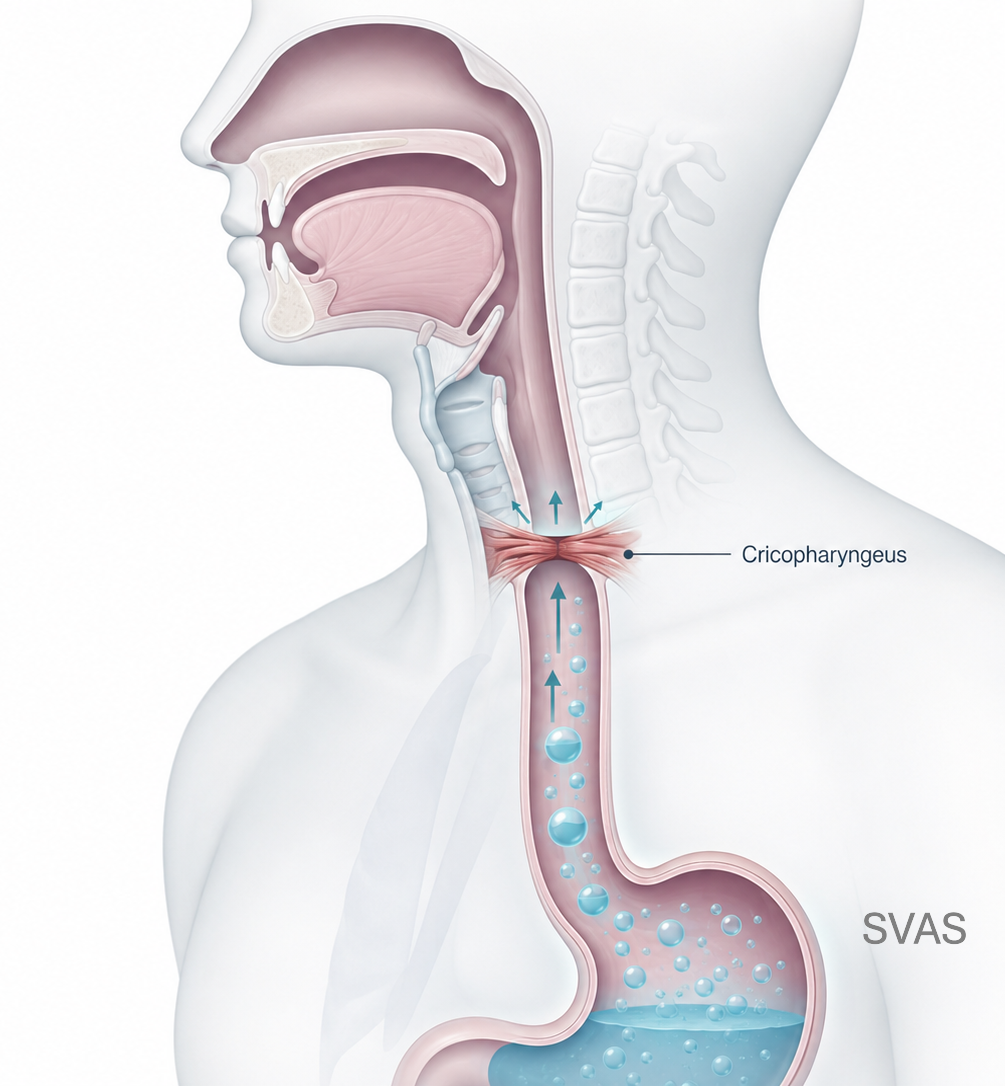
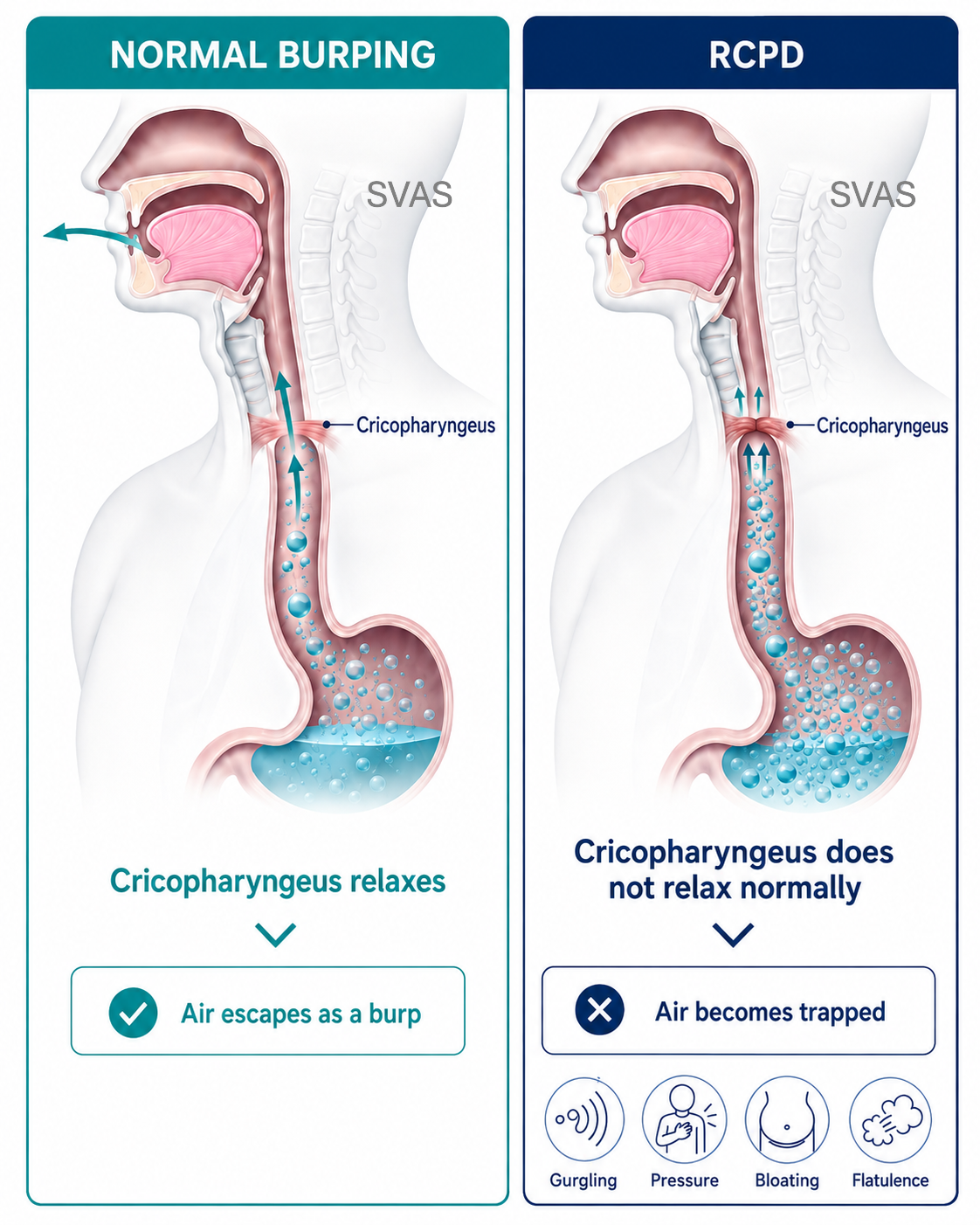
The cricopharyngeus is a ring of muscle at the top of the oesophagus. It normally relaxes when we swallow, allowing food and liquid to pass downwards.
It also needs to relax in the opposite direction when gas travels upwards from the stomach and oesophagus during a burp.
In RCPD, the cricopharyngeus does not relax normally when gas needs to escape upwards. Air can become trapped, producing the characteristic gurgling, pressure, bloating and excessive flatulence.
In simple terms: air rises normally — but cannot escape as a burp
How is RCPD diagnosed?
RCPD is primarily recognised from its characteristic symptoms and clinical history.
During your consultation, your specialist will ask about your ability to burp, gurgling, bloating, flatulence and other associated symptoms, and will consider whether another condition could be contributing.
Examination of the throat and larynx may be recommended. In some patients, further investigation may be appropriate depending on their individual symptoms.
A lifelong inability to burp, together with gurgling, bloating and excessive flatulence, is particularly suggestive of RCPD
Recognise the symptom pattern
No burping + gurgling + bloating + excessive flatulence
Specialist assessment
Clinical history and examination of the throat and larynx
Further investigation if needed
Additional tests may be recommended when symptoms suggest another possible cause
How is RCPD treated?
Treatment aims to temporarily relax the cricopharyngeal muscle so that air can begin to pass upwards through the oesophagus into the throat.
For appropriate patients, this is usually performed using a muscle-relaxing injection into the cricopharyngeal muscle.
The treatment approach is determined after specialist assessment and discussion of the expected benefits, limitations, risks and alternatives.
Patients who respond may begin noticing small burps during the days following treatment.
Target the cricopharyngeus
Treatment is directed at the muscle responsible for preventing retrograde airflow.
Temporarily relax the muscle
The aim is to allow air to move upwards and escape as a burp
Learn the new burping response
Patients may gradually develop the ability to burp over the following weeks
Australian RCPD Treatment Outcomes
Sydney Voice & Swallowing has published Australian clinical outcomes for patients treated for RCPD.
109
Patients in the published Australian series
71.6%
Reported complete symptom relief within 4 weeks
14.9%
Reported partial improvement within 4 weeks
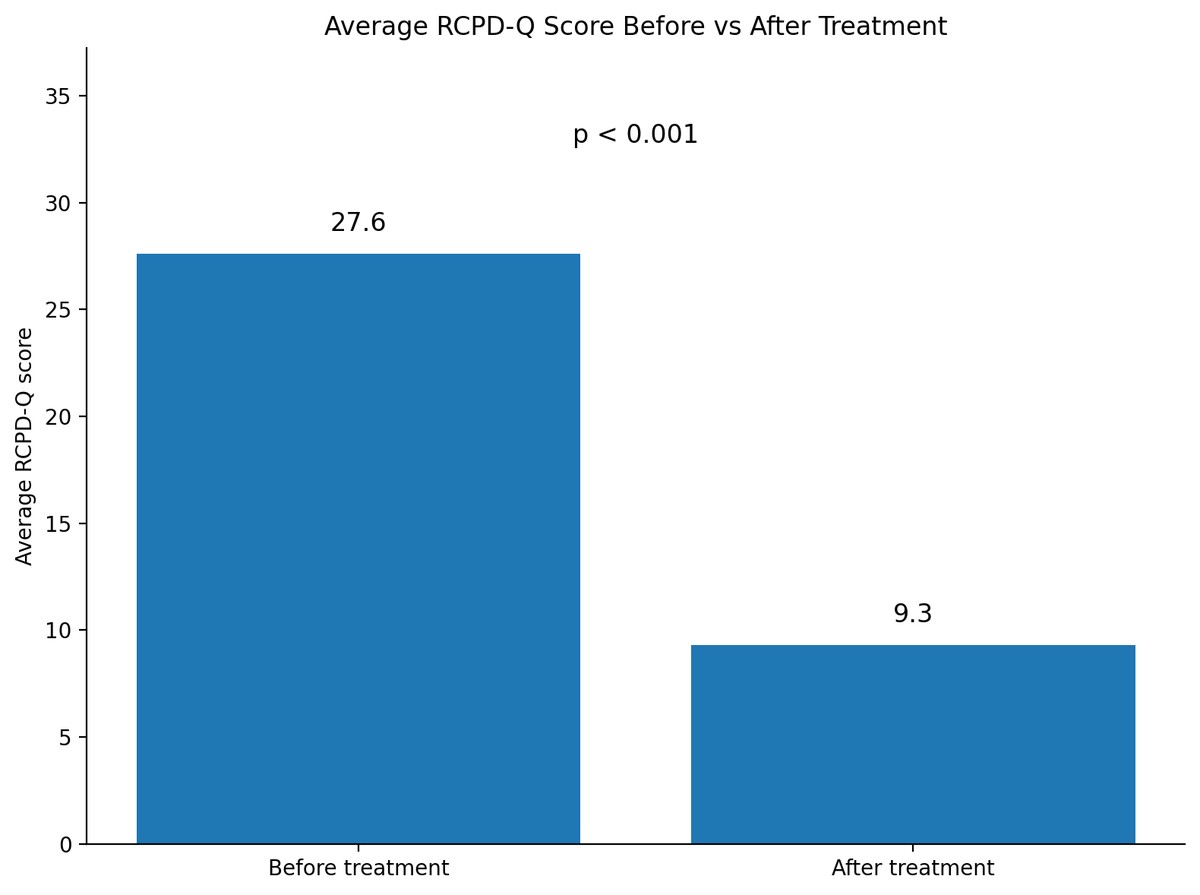
27.6→9.3
Average RCPD-Q score before vs after treatment
p < 0.001
Published Australian experience
Our published series examined 109 Australian patients with RCPD and found a significant reduction in symptom burden following treatment.
At the first follow-up within four weeks, 71.6% reported complete symptom relief and 14.9% reported partial improvement.
These results describe outcomes in a group of patients from our published clinical series. Individual responses vary and the figures do not predict the outcome for any individual patient
Why Choose SVAS for RCPD?
RCPD is a relatively recently recognised condition. Assessment and treatment are best provided by clinicians with specific expertise in the larynx, upper oesophagus, voice and swallowing
Specialist laryngology expertise
SVAS clinicians have subspecialist expertise in disorders of the larynx, upper oesophagus, voice and swallowing — the anatomy and physiology directly relevant to RCPD.
Published Australian RCPD experience
Our team has published clinical outcomes from an Australian RCPD patient series, providing local evidence on patient characteristics and treatment response.
Dedicated RCPD pathway
Patients are assessed specifically for RCPD, with treatment and follow-up tailored to the individual rather than using a generic ENT pathway.

A/Prof Daniel Novakovic
Laryngologist & ENT Surgeon
A/Prof Novakovic is an Australian-trained ENT surgeon with advanced fellowship training in laryngology and neurolaryngology in New York, as well as head and neck oncology. He is an Associate Professor at the University of Sydney and has published extensively in laryngology, including Australian clinical research on RCPD.

Dr Thomas Stewart
Laryngologist & ENT Surgeon
Dr Stewart is an Australian-trained ENT surgeon with subspecialty fellowship training in laryngology and neurolaryngology in New York. His practice includes voice, swallowing and upper-airway disorders, with expertise in office-based laryngeal procedures and treatment of laryngeal dysfunction
Travelling to Sydney for RCPD Assessment?
Sydney Voice & Swallowing assesses patients from across Australia with suspected RCPD.
If you live outside Sydney, our team can help clarify the likely assessment and treatment pathway before you make travel arrangements.
Contact our team
Tell us that you are seeking assessment for possible RCPD and that you live outside Sydney.
Initial assessment
Your specialist will review your symptoms and determine whether they are consistent with RCPD and whether any further assessment is required.
Plan your Sydney visit
If treatment is appropriate, our team can explain the likely timing of appointments and treatment so you can plan travel accordingly.
Initial telehealth consultations are available for suitable interstate patients, helping to clarify the likely pathway before travelling to Sydney.
Frequently asked questions about RCPD
These are some of the questions patients commonly ask about RCPD, assessment and treatment.
Is it normal not to be able to burp?
Some people burp less frequently than others. However, a longstanding or lifelong inability to burp, especially when associated with gurgling, bloating and excessive flatulence, is characteristic of RCPD and may warrant specialist assessment.
Is RCPD the same as no-burp syndrome?
Yes. “No-burp syndrome” or “aburpia” is a commonly used name for Retrograde Cricopharyngeal Dysfunction.
Why does my throat or chest gurgle if I can’t burp?
Air may rise through the oesophagus but fail to pass normally through the cricopharyngeus. Movement of this trapped air can produce the characteristic gurgling noises reported by patients with RCPD.
Why does RCPD cause bloating and excessive flatulence?
Air that cannot escape upwards remains within the gastrointestinal tract and eventually passes downwards, contributing to abdominal distension and excessive flatulence.
Can RCPD make it difficult to vomit?
Some people with RCPD report difficulty or inability to vomit, although this is not present in everyone.
How is RCPD diagnosed?
Diagnosis is based primarily on the characteristic symptom pattern and specialist assessment. Further examination or investigation may be recommended when another condition needs to be considered.
Is treatment available for RCPD?
Yes. For appropriate patients, treatment aims to relax the cricopharyngeal muscle so that air can begin to escape upwards.
How quickly might I notice a change after treatment?
Patients who respond may begin noticing small burps during the days following treatment. The timing and degree of response vary between individuals.
What happens if the first treatment does not work?
Your specialist can review the response and discuss whether further assessment, observation or additional treatment is appropriate.
Do I need a GP referral?
A GP referral is preferred for patients with Medicare as it gives us information about your health and also lets you claim a Medicare rebate for your consultation and any investigations or procedures
Can interstate patients be assessed?
Yes. SVAS assesses patients with suspected RCPD from across Australia in person or via telehealth. Our team can help explain the likely pathway before you travel.
Information for GPs and Referrers
RCPD is increasingly recognised as a distinct clinical syndrome. Consider referral when the characteristic symptom pattern is present, particularly when symptoms are longstanding or significantly affect quality of life.
Consider RCPD in patients reporting:
- longstanding or lifelong inability to burp
- characteristic throat or chest gurgling
- abdominal bloating or distension
- excessive flatulence
- symptoms worsened by carbonated drinks
- difficulty vomiting in some patients
Patients may have undergone previous gastrointestinal investigations without a clear explanation for their symptoms.
Recognise the pattern
The combination of inability to burp, gurgling, bloating and flatulence is particularly suggestive.
Refer for specialist assessment
SVAS provides assessment for suspected RCPD and considers whether further investigation is required.
Treatment planning
For appropriate patients, treatment options and follow-up are discussed after specialist assessment.